Donate funds
You donate what you can to Wisconsin Microfinance.
NEW! Check out our 2022 Annual Report to learn about the growth of our programs in the last year. 2022 Annual Report


Our mission is to provide access to capital (at a reasonable rate) to individuals (primarily women) who aspire to lift their families out of poverty by starting and running a small business.
We envision a world where the rural poor hold the power to create opportunity for themselves and others.
We are currently supporting entrepreneurs in Léogâne, Haiti, and on the island of Panay, Philippines. Since 2010, we have provided over 1,500 loans to entrepreneurs to build their own businesses and consistently demonstrated that an investment in individuals can improve the quality of life of their families and their communities.
Wisconsin Microfinance measures both the success of our programs in terms of money circulated, but also assesses improvements in quality of life of our loan recipients.


Give a man a fish, he’ll eat for a day. Give a woman microcredit, she, her husband, her children and her extended family will eat for a lifetime.
—Bono
Your support unleashed
Our programs are based on the microfinance model developed by Muhammad Yunus through the Grameen Bank. The Grameen Bank was founded on the belief that the very poor have unlimited potential, and unleashing their creativity and initiative can help end poverty.


You donate what you can to Wisconsin Microfinance.

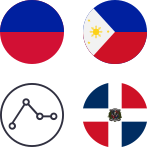

Your money is transferred to our partners.


The money is used to make loans to entrepreneurs in the communities.


When the loans are repaid, the money is used to make additional loans.
When you donate to Wisconsin Microfinance, you are empowering families with the resources needed to rise above poverty.
Host a fundraiser, make a recurring contribution, or participate in a corporate or congregational partnership to support our work.
Enter your email address to sign up for our newsletter.
Evan Lory recently had the privilege of traveling to the Dominican Republic to deliver funding for loans for female business women. While there, he met many loan recipients and learned about the kinds of businesses that are being funded.
It was Evan Lory’s first trip to a developing country. Upon arrival, he quickly realized how much he takes for granted, where necessities like clean water, electricity, education, and healthcare seem so commonplace. At the same time, he realized how much alike we all are.


